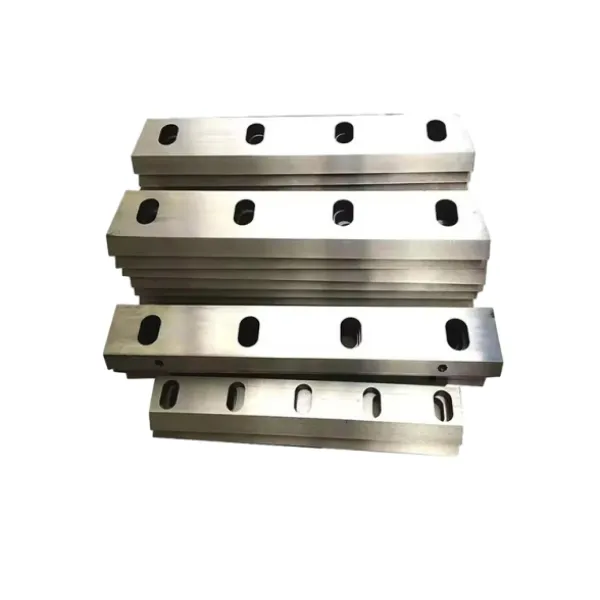
High Efficiency Rubber Granulator Precision Roller Manufacturer
Maintaining consistent particle size in rubber recycling requires more than just heavy machinery; it demands high-precision cutting geometry and advanced metallurgy. For operators managing waste tire recycling or modified rubber preparation, the efficiency of the granulation process hinges on the durability and sharpness of the cutting rollers. When the material's elasticity varies—ranging from soft natural rubber to steel-reinforced tires—the choice of blade material and tooth structure determines whether a plant achieves maximum throughput or suffers from frequent downtime due to blade wear.
As a specialized precision roller manufacturer, Changzhou Binsheng Metallurgical Machinery Co., Ltd. focuses on engineering rubber granulator blades that balance impact resistance with extreme hardness. By integrating heat-treated alloy steels and specialized coatings, these components ensure that rubber waste is accurately processed into uniform particles, facilitating seamless reuse in injection molding and extrusion lines while minimizing resource consumption.

Engineering Requirements for High-Efficiency Rubber Granulation Systems
Rubber granulation is a demanding process that subjects cutting tools to simultaneous abrasive wear and heavy impact. The primary goal is to convert large, irregular waste pieces—such as tires, conveyor belts, and industrial seals—into precise, uniform granules. To achieve this, the cutting system must handle high elasticity and often contend with embedded impurities like steel wires or carbon black fibers. If the blade geometry is suboptimal, the rubber tends to "fold" rather than cut, leading to irregular particle sizes and increased energy consumption.
Modern granulators typically employ two primary cutting mechanisms: granulation rollers and crusher blades. Granulation rollers utilize circular designs with tooth structures (commonly 12 or 18 teeth) to shape particles through high-speed rotary extrusion. In contrast, crusher blades use a combination of moving and fixed flat structures to shred the material. The critical technical challenge lies in the cutting gap adjustment; a precision-engineered gap is essential to maintain a particle size accuracy of ± 0.5mm, which is the standard for high-grade recycled rubber raw materials.
Furthermore, the thermal properties of the material play a significant role. During high-speed rotation, friction generates heat that can cause rubber to melt and adhere to the blade surface. This "rubber adhesion" not only degrades cutting precision but also creates a drag effect that strains the motor. Consequently, the integration of specialized anti-adhesion coatings and optimized heat treatment is necessary to ensure long-term operational stability in continuous production environments.

Material Selection and Metallurgical Performance Comparison
The selection of tool steel is the most critical decision in extending the service life of granulator blades. Depending on the specific application—whether it is pure natural rubber or steel-belted tire waste—different metallurgical properties are required. At Changzhou Binsheng, we utilize a range of high-performance alloys to match the specific stress profiles of the customer's operational environment.
For general rubber granulation, Cr12MoV is often the optimal choice. It offers a balanced hardness (HRC 58-62) and excellent wear resistance, making it suitable for the majority of industrial rubber materials. However, for high-load, continuous operations—such as the production of rubber accelerators—hard metal (carbide) is preferred. While carbide is more brittle, its extreme hardness (HRC 65-70) allows it to maintain a sharp edge for significantly longer periods, reducing the frequency of replacement cycles.
In scenarios involving intermittent granulation or smaller-scale equipment, high-speed steel (HSS) provides a cost-effective alternative. HSS maintains a hardness of HRC 55-58 and offers superior toughness, which is essential when processing tire waste that may contain heavy steel wire inserts. To further enhance performance, titanium nitride coatings can be applied, which drastically reduce the coefficient of friction and prevent the aforementioned rubber adhesion issues, thereby extending the blade's effective lifespan.
Operational Application Scenarios and Integration Logic
The application of granulator blades varies significantly based on the raw material purity and the desired end-use of the rubber particles. Understanding these scenarios allows for the selection of the correct blade type and maintenance schedule to optimize total cost of ownership.
- Rubber Waste Recycling: The focus here is on volume and durability. Blades are used to shred tires into uniform particles for use as recycled raw materials. High-impact resistance is prioritized to prevent chipping when hitting steel belts.
- New Material Preparation: In the production of modified rubber (composite materials with carbon black), the priority is precision. Accurate granulation ensures that the particle size meets the strict requirements of subsequent injection molding or extrusion processes.
- Mixed Material Processing: When processing conveyor belts or sealing rings that contain metal inserts, the system must achieve impurity separation through granulation. This requires blades that can handle "shock" loads without losing their cutting edge.
To maximize the efficiency of these applications, a structured maintenance routine is imperative. Daily cleaning using high-pressure air guns prevents rubber residue from melting onto the blades. Additionally, lubricating the blade shaft bearings with lithium-based grease every 50 hours reduces metal fatigue and prevents premature bearing failure. For those seeking a technological upgrade, the implementation of dynamic adjustment systems equipped with pressure sensors can real-time optimize blade clearance and speed, further increasing yield.
Blade Material Performance and Application Matrix
| Material Type | Hardness (HRC) | Wear/Impact Resistance | Recommended Scenario |
|---|---|---|---|
| Cr12MoV | 58-62 | High / Medium | General rubber & industrial waste |
| Hard Metal (Carbide) | 65-70 | Extreme / Low | High-load continuous granulation |
| High-Speed Steel | 55-58 | Medium / High | Tire waste with steel wire |
| Titanium Coated | Variable | Enhanced / Medium | High-adhesion natural rubber |
| Composite Coating | Variable | Extreme / Medium | Precision high-tech granulation |
Procurement Considerations for Industrial Cutting Components
When sourcing granulator blades, procurement managers should move beyond initial price points and evaluate the cost-per-ton of processed material. A cheaper blade that requires replacement every 200 hours is significantly more expensive than a high-grade alloy blade that lasts 1,200 hours when accounting for labor costs and production downtime.
Key evaluation criteria should include the heat treatment certification and the consistency of the hardness profile across the blade's surface. Non-uniform hardness often leads to premature edge failure or catastrophic cracking under impact. Buyers should also inquire about the manufacturer's ability to provide customized tooth geometries; for instance, adjusting the tooth count from 12 to 18 can significantly alter the particle size distribution and the load on the granulator motor.
Furthermore, verify the supplier's quality management system. ISO 9001 certification ensures that the metallurgical process—from raw material sourcing to final grinding—is standardized. For enterprises operating in the Yangtze River Delta or exporting to North America and Europe, partnering with a manufacturer that understands international shipping and technical standards is vital for reducing procurement lead times and ensuring seamless equipment integration.
Future Trends in Rubber Processing Technology
The rubber granulation industry is shifting toward "intelligent wear management." The integration of IoT sensors into the blade assembly allows operators to monitor wear patterns in real-time, moving from scheduled replacements to predictive maintenance. This shift minimizes the risk of unexpected failures that can halt entire production lines.
On the materials front, the development of composite coatings—combining tungsten carbide with diamond-like carbon (DLC)—is showing promising results. These advanced coatings can increase wear resistance by up to 40%, potentially extending blade lifespan to 1,500 hours or more. This is particularly beneficial for the processing of high-abrasion modified rubbers and carbon-filled composites.
Sustainability is also driving innovation. As the demand for high-purity recycled rubber grows for the automotive and footwear industries, the requirement for tighter granulation tolerances (below ± 0.5mm) will increase. This will necessitate a move toward dynamic clearance systems that can automatically adjust the gap between moving and fixed blades during operation to compensate for natural wear, ensuring consistent product quality throughout the blade's lifecycle.
Technical FAQ: Rubber Granulator Blade Selection
What is the main difference between granulation rollers and crusher blades?
Granulation rollers are circular blades with tooth structures (e.g., 12 or 18 teeth) that shape particles through high-speed rotary extrusion, ideal for precise particle size. Crusher blades use a flat structure combining moving and fixed blades to shred larger waste, focusing more on volume reduction than precision.
Which material is best for processing tires containing steel wire?
High-speed steel (HSS) or specific alloy steels with enhanced impact resistance are recommended. Pure hard metal/carbide may be too brittle and prone to chipping when encountering steel wires, whereas HSS provides the necessary toughness to handle these impurities.
How often should rubber granulator blades be replaced?
Replacement cycles vary by material: Cr12MoV blades typically last 200-400 hours, while hard alloy blades can last 800-1,200 hours. This depends heavily on the abrasiveness of the rubber and the presence of impurities.
How can I prevent rubber from adhering to the blades?
The most effective methods are applying specialized coatings like titanium nitride to reduce surface friction and implementing a daily cleaning routine using high-pressure air guns to remove residue before it melts onto the cutting edge.
What is the impact of blade hardness on particle size accuracy?
Higher hardness helps maintain a sharp cutting edge for longer, which is essential for keeping the cutting gap consistent. When blades dull, the material is pushed rather than cut, increasing the particle size variance beyond the typical ± 0.5mm tolerance.
Can these blades be customized for specific granulator brands?
Yes, precision components can be tailored to specific operational requirements, including customized tooth counts, specific dimensions for various screw systems, and specialized heat treatments to match the host granulator's torque and speed.
Technical References & Industry Standards
- ISO 9001 Quality Management Systems for Manufacturing
- ASTM International Standards for Tool Steels
- Industrial Rubber Processing & Recycling Guidelines
- Research on Alloy Steel Wear Resistance in Granulation
Selecting the right cutting tool is a balance of metallurgy, geometry, and maintenance. Whether you are scaling up a recycling plant or optimizing a precision production line, the right blade specification can drastically reduce operational costs. For technical consultations on material selection or customized blade designs, our engineering team is available to provide tailored solutions.
Related Industrial Cutting Solutions